



Vietnam is a long, diverse country full of contrasts, from mountains and rice terraces in the north to tropical beaches and the Mekong Delta in the south. There are plenty of options… and time is almost always limited.
So before booking domestic flights or adding destinations at random, be clear on how many days you have and what kind of experience you want. One week isn’t two, and staying in the north isn’t crossing the whole country.
This guide helps you plan your route by trip length: what to see in 7 days, how to stretch it to 2 weeks and what to add with more time. The idea is to choose well and enjoy each place without rushing.
Quick logistics (in 30 seconds)
Passport: at least 6 months’ validity from your arrival.
Visa: many nationalities (including most of Europe) get 45 days visa free; others need the e-visa, applied for online and simple.
Travel insurance: strongly recommended. Private healthcare here is excellent but very expensive.
How to plan your Vietnam itinerary
Map of Vietnam by trip length
For a quick visual overview, I’ve marked the most interesting places on the map according to the time you have. That way you can see which areas to prioritise and which to leave for another trip.
🟥 Red: must sees on a first trip or with only one week.
🟨 Yellow: ideal to extend to two weeks (Hue and Ho Chi Minh City are optional).
🟩 Green: less visited regions, perfect with more time or if you’ve already seen the essentials.
After the map there’s a clear summary by number of days.
Quick summary by number of days
At a glance, these are the recommended routes by trip length.
| Days | Key regions | Suggested itinerary |
|---|---|---|
| 7 | Northern Vietnam | Hanoi, Sapa, Ninh Binh, Halong/Cat Ba |
| 14 | North + Centre | + Hoi An, Da Nang, Hue (optional: Ho Chi Minh City) |
| +15 | Various | Ha Giang, Phong Nha, Con Dao, Mekong Delta… |
Where to start? Hanoi or Ho Chi Minh City
As the map and summary show, the essentials for a first trip are in the north. So in most cases, starting in Hanoi is the most practical option.
- Start in Hanoi if you have 10 days or less, want to see the most spectacular places without domestic flights, and prefer a simpler trip: north and back.
- Start in Ho Chi Minh City if you have two weeks or more and fancy crossing Vietnam, found much cheaper flights, or are especially interested in the city. It played a key role in the Vietnam War, and its highlights are the War Remnants Museum and the Cu Chi tunnels.
If you fly into one city and out of another, you’ll usually add at least one domestic flight to avoid losing days in transit. Compare international and domestic flights here.
What to see in Vietnam in 7 days (the classic northern route)
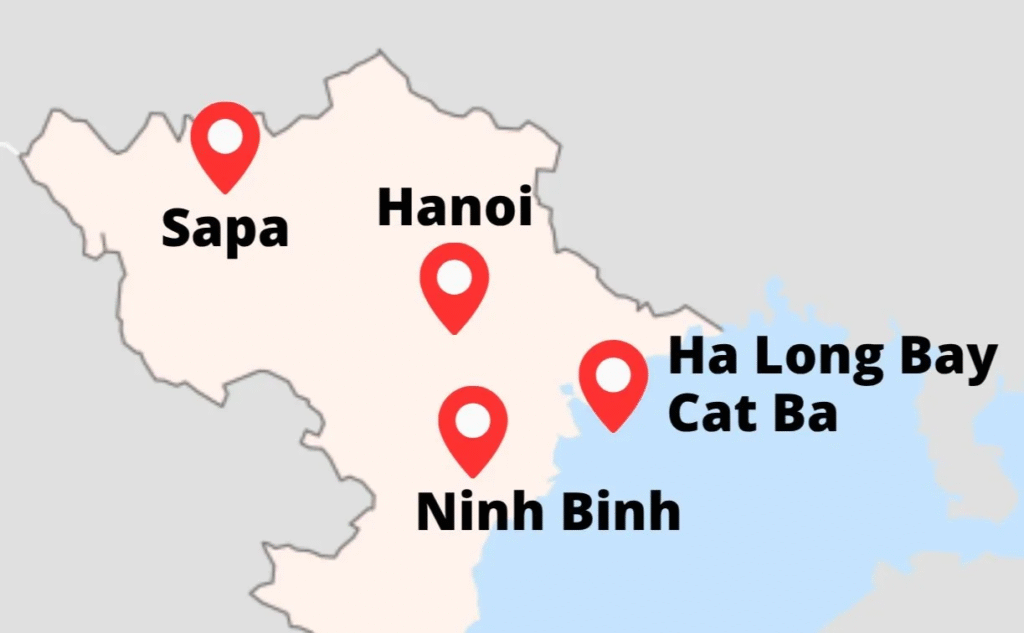
With only one week, I recommend the highlights of northern Vietnam:
- 1 day in Hanoi. First contact with Vietnam: lively streets, temples, local food tours, walks around the Old Quarter, parks, pagodas and museums.
Hanoi guide - 1 to 2 days in Ninh Binh. Spectacular scenery, river boat trips, caves and temples.
Ninh Binh guide - 2 days in Halong or Cat Ba. A cruise among the rock formations, or exploring from the island.
How to visit Halong/Cat Ba - 2 days in Sapa. Trekking, rice terraces and ethnic minority villages.
Sapa guide
A logical, balanced order: Hanoi → Ninh Binh → Halong or Cat Ba → Sapa → Hanoi. You can swap Sapa and Ninh Binh depending on weather or transport times.
Most transfers go through Hanoi. To save time, use sleeper buses, especially for Sapa ↔ Hanoi, Sapa ↔ Ninh Binh or Sapa ↔ Halong/Cat Ba: you travel while you sleep and save a night’s hotel. Everything about these buses and how to book them is in my complete guide to getting around Vietnam.
If you prefer the comfort of the train, Hanoi ↔ Lao Cai (Sapa) is still a classic, although the bus is faster and drops you right in town.
Alberto’s tip: this itinerary means moving roughly every 2 days, so it’s a busy trip. For a calmer pace, drop one destination. With 1 or 2 spare days, add time to Hanoi, Ninh Binh, Sapa or Cat Ba.
15 day route through Vietnam (north, centre and Hoi An)
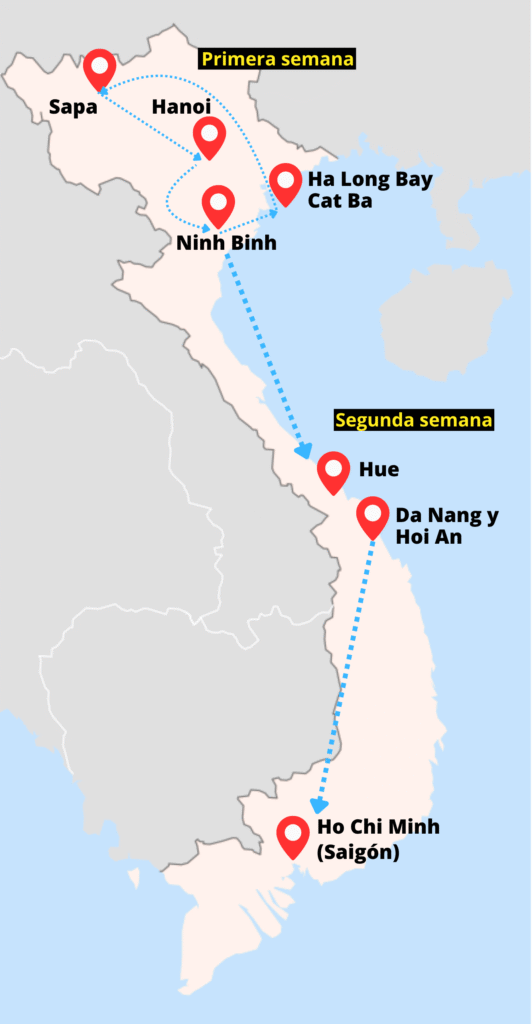
With around 14 days, you can see the north calmly and add the centre of the country, where the landscape changes completely: historic cities, long beaches and a more relaxed vibe.
🗺️ Quick route summary (14 days)
Hanoi → Ninh Binh → Halong or Cat Ba → Sapa → Hanoi
✈️ Central Vietnam (Da Nang / Hoi An / Hue)
What to visit in central Vietnam
- 3 to 4 days between Hoi An and Da Nang. A lantern lit old town, beaches like An Bang or My Khe, the Marble Mountains, the Hai Van Pass, Ba Na Hills and trips to My Son or the Cham Islands.
Hoi An recommendations - 1 to 2 days in Hue. Imperial city, royal tombs and a calm atmosphere by the Perfume River.
Local recommendations in Hue (in Spanish)
With this combination you’ll get a very complete picture of the north and centre in 14 days.
How to connect the north and centre
The most practical way is to fly from Hanoi to Da Nang or Hue (both have airports). You can also take a night train or bus from Hanoi or Ninh Binh, although it’s a long journey. Check bus and train options on Baolau.
How to connect Hue and Da Nang/Hoi An (the Hai Van Pass)
If you’re visiting Hue, Da Nang and Hoi An, one of the most interesting ways to connect them is over the Hai Van Pass, one of Vietnam’s most beautiful scenic roads.
- Recommended route. Fly to Hue (or arrive by train or bus), cross the Hai Van Pass by motorbike or car to Da Nang or Hoi An, then fly on from Da Nang airport. It also works the other way round.
- How to do it. On your own with a rented motorbike, or with a driver. An option that has worked very well for many readers is Le Family Riders: motorbike with driver or private car, with stops along the way. Book by messaging them on WhatsApp and mention the code ALBERTOVN50 for 50,000 VND off per person. Every option for crossing it (motorbike, easyrider, car or train), with prices and my experience, is in my Hai Van Pass guide.
Other practical tips:
- Where to stay for Da Nang and Hoi An. To visit both, it’s easiest to stay in Hoi An and move from there. Value for money in Hoi An is excellent, by the beach or in the old town.
- Is Hue worth it? Hue has lots of charm, known for its imperial history, royal mausoleums and citadel. But if you’re short on time, or history and architecture aren’t your priority, focus on Hoi An and Da Nang.
Optional: finish in Ho Chi Minh City (2 days)
To end your trip in the south, fly to Ho Chi Minh City, Vietnam’s largest city and the former southern capital during the war.
Highlights in Ho Chi Minh City: the powerful War Remnants Museum, the Cu Chi tunnels (half day trip) and a walk around the city, including Notre Dame Cathedral, the Post Office, Thien Hau temple and Nguyen Hue street.
Ho Chi Minh City guide
What to see in Vietnam in 3 weeks or more (destinations for longer trips)
With 3 weeks or more, it’s no longer just about «seeing the essentials», but choosing which Vietnam you want: more adventure, nature, beach or history.
Some ideas, ordered by preference within each area:
More places in the north
- Ha Giang Loop (3 to 4 days, by motorbike or 4×4; in Spanish)
Spectacular roads and ethnic culture. - Mu Cang Chai
Incredible scenery, treks and rural life. - Pu Luong
Hiking among rice fields, rivers and quiet villages. - Mai Chau
Rice fields and ethnic life among the mountains. - Vu Linh
Near Thac Ba Lake, for swimming, kayaking and local ethnic groups. - Moc Chau
Cool climate and rural scenery among tea plantations.
More places in the centre
- Phong Nha, Ke Bang
National park with jungle scenery and some of the world’s largest caves. - Demilitarised Zone (DMZ)
The former border between north and south during the war, with tunnels and historic military bases. - Tam Thanh
Small coastal village decorated with colourful murals and a local vibe.
More places in the south (in order of preference)
- Can Tho
The most authentic way to explore the Mekong Delta, through its floating markets and canals. - Con Dao
Quiet island with natural beaches, history and good snorkelling. - Phu Quoc
The south’s most developed island, with resorts and a tropical vibe. - Da Lat
Mountain city with a cool climate, waterfalls and colonial architecture. - Tuy Hoa
Small coastal town, rural and still little explored. - Mui Ne
Wide beaches and red and white sand dunes. - Nha Trang
Beach city with good infrastructure and a more urban feel.
Prefer it explained on video?
A while ago I recorded a video (in Spanish) on what to see in Vietnam depending on your days. It’s old, but the information is still valid and may help you picture the route.
Questions about your itinerary? Leave a comment below and I’ll try to help. I’ve also just started a WhatsApp group in English: it’s small for now, but you’re very welcome to join and share your route.