


Last updated: 13 July 2026
Since 15 April 2026, Vietnam has a new requirement for travellers arriving in the country: filling in a digital pre arrival declaration before going through immigration. You can do it before you fly and it creates a QR code that you show when you land (you’ll also see it called the pre arrival card or digital arrival card).
In practice, it works like in other countries in the region such as China or Cambodia: lots of people end up filling it in while queuing before passport control. I came in through Hanoi in July 2026 and did it there in just a few minutes.
Below I explain everything you need to know about this pre arrival card.
What exactly is it?
It’s a free online form that collects your personal details, passport information, flight details and the address where you’re staying in Vietnam. Once it’s done, the system creates a QR code. Save it on your phone: in theory you show it to the immigration officer when you arrive, although in practice they just scan your passport to see your details.
The form is on the official Vietnam Immigration Department portal: prearrival.immigration.gov.vn. You can do it from 72 hours (3 days) before your flight, not earlier.
It’s separate from your visa and doesn’t replace it. If you need a visa to enter Vietnam, that’s a different process, which I cover in my Vietnam visa guide (in Spanish for now).
Who needs to fill it in?
According to the official announcement from the Ho Chi Minh City immigration office, these people must fill it in:
- All passengers with foreign nationality entering Vietnam.
- Vietnamese people living abroad who travel on a foreign passport.
You don’t need to fill it in if you are:
- A Vietnamese citizen travelling on a Vietnamese passport.
- A transit passenger who doesn’t go through immigration.
What about travellers entering visa free?
The official announcement says “all passengers with foreign nationality”, which includes people from visa exempt countries (in Spanish), such as Spain or the UK.
Which airports does it apply to?
Visitors entering through the following international airports should fill in the form:
- Hanoi airport (Noi Bai)
- Da Nang airport
- Nha Trang airport (Cam Ranh)
- Ho Chi Minh City airport (Tan Son Nhat)
- Phu Quoc airport
It only applies to international flights. If you fly within Vietnam (Hanoi to Da Nang, for example) you don’t need to fill in anything. The declaration is for entering the country, not for every flight you take.
The form also has options for arriving by land and by sea. If you cross from Cambodia or Laos at a land border, you’ll see the system lets you choose that. However, the Immigration Department itself has said that using it at land borders is still being studied.
How do you fill it in?
The whole process happens on the official portal and takes about five minutes. Roughly, these are the steps:
- Open the portal, choose your language, press the blue button, “Create & Submit Pre-arrival Information”, and solve the captcha.
- Scan your passport (or press “Skip”) and choose your nationality.
- Fill in your personal and passport details and your visa.
- Enter your flight, arrival airport and accommodation in Vietnam.
- Confirm, verify with the code sent to your email and save the QR code on your phone.
Tip: save the QR code as a screenshot before you board, in case you have no signal when you land.
I explain every field with screenshots, plus the usual sticking points (finding your country, which visa type to choose, how to enter the address), in my step by step guide to filling in the arrival card.
Official video from the Vietnam Immigration Department showing the whole process, step by step.
Do you have to fill it in in advance?
It’s not compulsory to do it in advance, but you’re expected to have it done before you go through immigration.
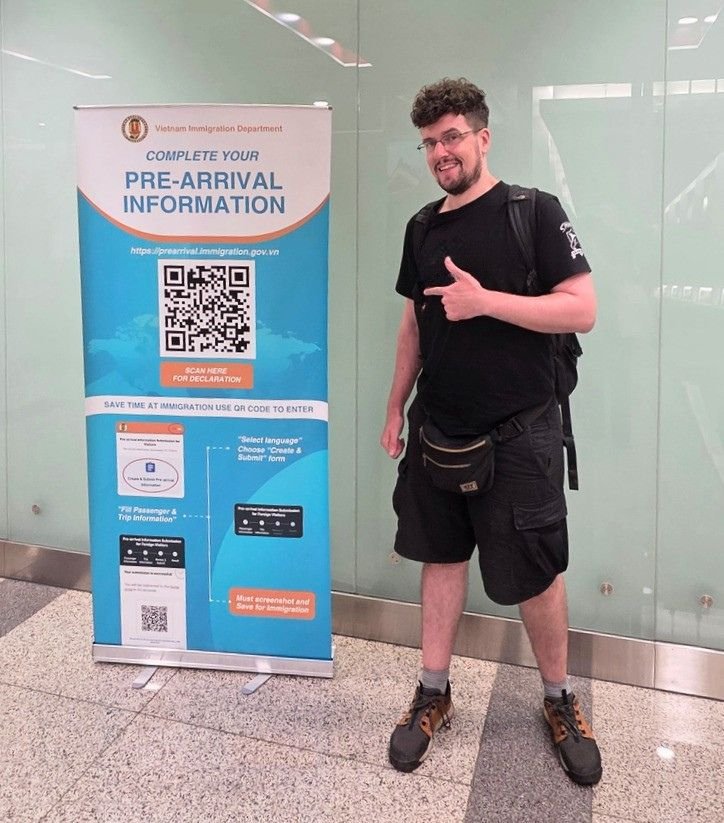
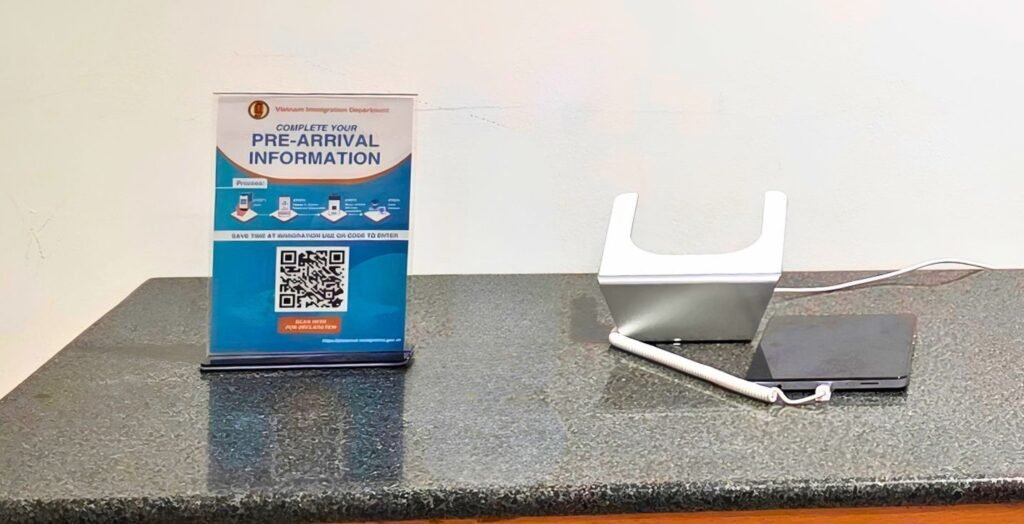
At the airport, as you walk towards immigration there are signs reminding you to do the declaration, and just before the queue there are stands with QR codes, posters and even tablets to fill it in on the spot. This matches what happens in other countries in the region where the system has been around longer, such as China or Cambodia: on paper you’re supposed to fill it in beforehand, but in practice lots of people do it on the go.
My own experience: I came in through Hanoi in July 2026 without the form done, filled it in while queuing and had no problems at all. In fact, when I went to show the officer my QR code, he told me it wasn’t needed.
And it’s not just me: I run WhatsApp groups (mostly in Spanish) with hundreds of travellers who arrive in Vietnam all the time, and so far not a single one has told me they were asked for the QR code at immigration. Not in Hanoi, not in Ho Chi Minh City, not at any other airport. This may change as the system beds in, so I’ll keep this article updated.
Something to keep in mind: to fill it in, you need an internet connection. I used my own Vietnamese SIM card, but I saw people struggling with the airport wifi. One tourist even asked me to share my data because he was in the queue and couldn’t get online. If you arrive with an eSIM already active, it comes in handy here. I explain which one I use and why in my Vietnam eSIM guide.
Should I fill it in before I fly or when I land?
Both are completely fine. The best choice depends on how you travel and what matters to you when you land:
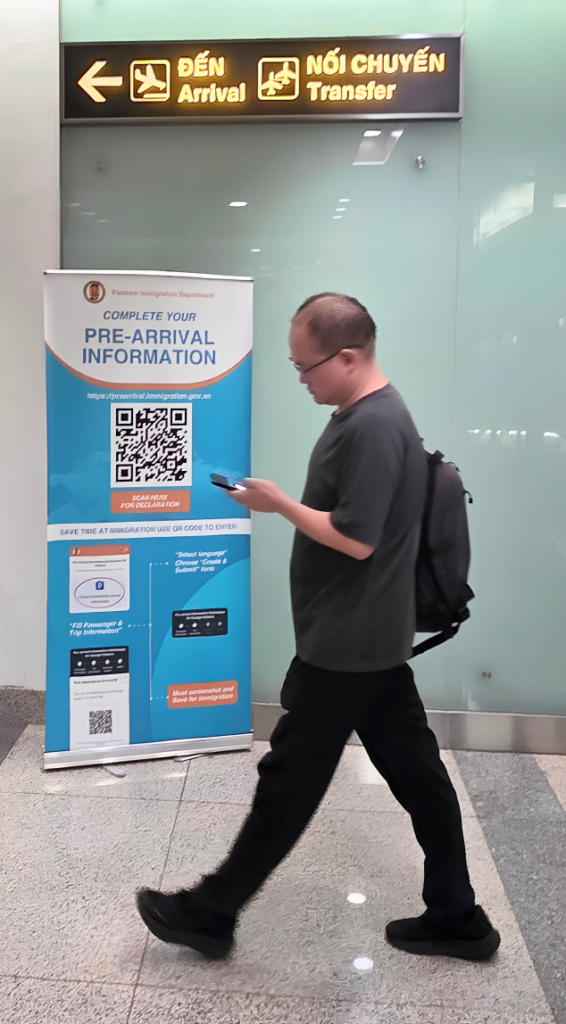
- When you land (the easy option): great if you don’t want to think about it. There are signs explaining it before immigration and you can do it in the queue in five minutes. Watch the connection: the airport wifi can get overloaded. An eSIM solves that, or you can stop and fill in the form before you join the queue.
- Before you fly (for planners): if you’d rather land with it all sorted, do it at home. You arrive with your QR code saved on your phone, you don’t depend on the airport wifi after a long flight and you can forget about it.
- Special case: you’re in a hurry, travelling with children or have a tight connection. Immigration usually takes 30 to 40 minutes, but sometimes longer depending on how many flights land at once. If your goal is to get through passport control and out of the airport as fast as possible, I’d combine two things:
- Fill in the form in advance (before your flight).
- Book a fast track service to skip the immigration queues. You can book it through this link (I compared several platforms and this one had the best price).
In short: if you don’t want any hassle before your trip, do it when you land. If you like to plan ahead, do it at home (probably the best way to avoid stress). And if you want to get out of the airport as fast as possible, have the declaration ready and book Fast Track.
FAQ
Do I need a declaration for each person if I’m travelling as a family or group?
Yes, you need each person’s details, including children and babies. But you don’t have to start from scratch each time: inside the form there’s an “Add passenger” button. Press it and you can add your family or group members in the same session, filling in each person’s passport details before sending the joint application.
Do I need to print the QR code or is my phone fine?
Your phone is absolutely fine. A screenshot you can find quickly is enough. If you’d rather have a paper copy just in case, you can print it, but you don’t have to.
Do I need to fill it in for a domestic flight within Vietnam?
No. The declaration is only for entering the country on an international flight. If you later fly from Hanoi to Da Nang, for example, you don’t need to fill in anything else.
Do I need it if I arrive overland from Cambodia or Laos?
For now, don’t worry: today, in practice, the system is used at airports, not at land borders.
The form includes an overland option, but the Immigration Department has said that using it at land borders is still being studied, and so far no traveller in my community has told me they were asked for it when crossing by land. So if you’re coming from Cambodia, Laos or China, you can relax.
Can I fill it in when I arrive at the airport?
Yes, you can do it after landing. You’ll see stands and signs before the immigration queue. Just make sure you have data (or an active eSIM) so you don’t depend on the airport wifi, which sometimes fails.
What if I make a mistake?
Don’t worry, it’s not the end of the world. Go back to the official portal, click the button to search and update your declaration, and enter your registration details to correct it without starting again.
How often do I need to fill it in if I enter and leave several times?
You need to fill it in every time you enter Vietnam on an international flight. It’s linked to each specific entry, so if you leave the country and come back, you’ll need a new QR code for that trip.
A note on sources
The most reliable sources I’ve found are:
- The official announcement from the Ho Chi Minh City immigration office (Quản lý xuất nhập cảnh TPHCM).
- The notice from the US Embassy in Vietnam, which confirms the requirement from 15 April, and its note of 17 June announcing the extension to more airports.
- Official letter (Công văn) number 1474/CACK TSN from the Immigration Department, which is the legal basis but isn’t published online.
- A note on the website of the Ministry of Public Security, which explains how the system works, the results of the pilot and the warning about fake websites.
As often happens in Vietnam, the system was launched before there was clear, detailed public documentation. That’s why a lot of what I tell you here comes from my own entry into the country and what travellers in my community report.
Next steps for your trip
Paperwork and visas:
Landing and getting ready: start with how to change money and pay in Vietnam, then:
- Internet in Vietnam: local SIM card or eSIM?
- How to get from Hanoi airport to the city centre
- What to pack for Vietnam
Travelling soon? I’ve also just started a WhatsApp group in English. It’s small for now, but you’re very welcome to join and ask anything about your trip.