

I’ve lived in Vietnam since 2017, and if I had to answer the title in one sentence: yes, Vietnam is a very safe country. In many ways I feel more relaxed walking around Hanoi at eleven at night than in parts of many European cities.
That doesn’t mean there’s nothing to watch out for, but most of it isn’t muggings or violent theft: it’s small tourist scams, mix ups with money, mosquitoes and traffic. Easy to avoid if you know about them in advance.
Here I share the most important things to be careful about in Vietnam, from my own experience and from running WhatsApp groups for travellers (mostly in Spanish), where every week I hear what has happened to people and which mistakes keep coming up.
Is Vietnam safe? The short answer
Yes. Vietnam is one of the safest countries in Southeast Asia and the world when it comes to street crime, violent theft or muggings. One of the things visitors notice most is how kind and warm Vietnamese people are.
Over the years I’ve heard of the odd isolated case of a bag or phone snatched from a passing motorbike in parts of central Hanoi and Ho Chi Minh City. It’s very rare, but take the basic precautions you’d take in any big city: don’t hold your phone near the road, wear your bag across your front, and don’t carry your backpack on one strap.
That said, there are two kinds of «dangers» worth keeping in mind, which this article covers:
- Tourist scams in busy tourist areas (taxis, cyclos, street “gifts”, mix ups with money).
- Everyday physical risks, mainly traffic and mosquitoes.
None is serious if you know what to expect, and that’s what this article is for.
Scams and tourist traps
Dishonest taxi drivers
In tourist areas and at the airport there are quite a few reports of scams: rigged meters that run too fast, drivers who don’t switch the meter on and charge what they like, and in extreme cases, doors locked until the passenger pays.
It happened to me too, after living here a while, because I got overconfident. I tell the story here (in Spanish):
It happens often enough to avoid the risk from the start. The solution is simple: apps like Grab or Green SM, which work like Uber. You order a car or motorbike on your phone, see the price before you get in and pay in cash or by card. No haggling, no surprises, no arguments.
I use Grab and Green SM all the time and totally recommend them: setting them up is well worth it, because they save you time, money and awkward situations. My article on essential apps explains which apps to install before your trip to Vietnam.
And if you’re arriving in Hanoi, in my guide on how to get from the airport to the city centre I explain every option (bus, apps, car with driver, taxi) and which one is worth it.
Watch out for dating apps like Tinder in Hanoi and Ho Chi Minh City
This scam has become a classic in Hanoi, especially around the Old Quarter, and also happens in Ho Chi Minh City. It repeats so often that it deserves its own section.
It works like this: a traveller opens Tinder after arriving and starts chatting with a stunning Vietnamese girl who, after a few messages, suggests a drink in a very specific part of the centre. They meet on the street and go to the bar. She orders a combo of drinks and snacks, and the bill can easily reach $230 to $290. If the traveller refuses to pay, intimidating security staff appear. The bar, the girl and the «security» are all part of the same set up, and there are also versions with dinner first at places with no menu on show, where the bill is also inflated.
The clearest sign is speed. If you contact a girl at eleven at night and after a few messages she suggests a specific spot in the centre with a Google Maps link, be suspicious. Women looking for a real date tend to chat for days, ask questions and see if there’s chemistry. Rushing to meet and insisting on a specific place are the two clearest red flags.
My advice: if you match with someone on Tinder or similar apps in Vietnam and they insist on a specific spot in the centre, especially in Hanoi’s Old Quarter or Bui Vien in Ho Chi Minh City, suggest somewhere else. If they insist on that exact place, you have your answer.
Cyclos and shoe shiners: agree the price first
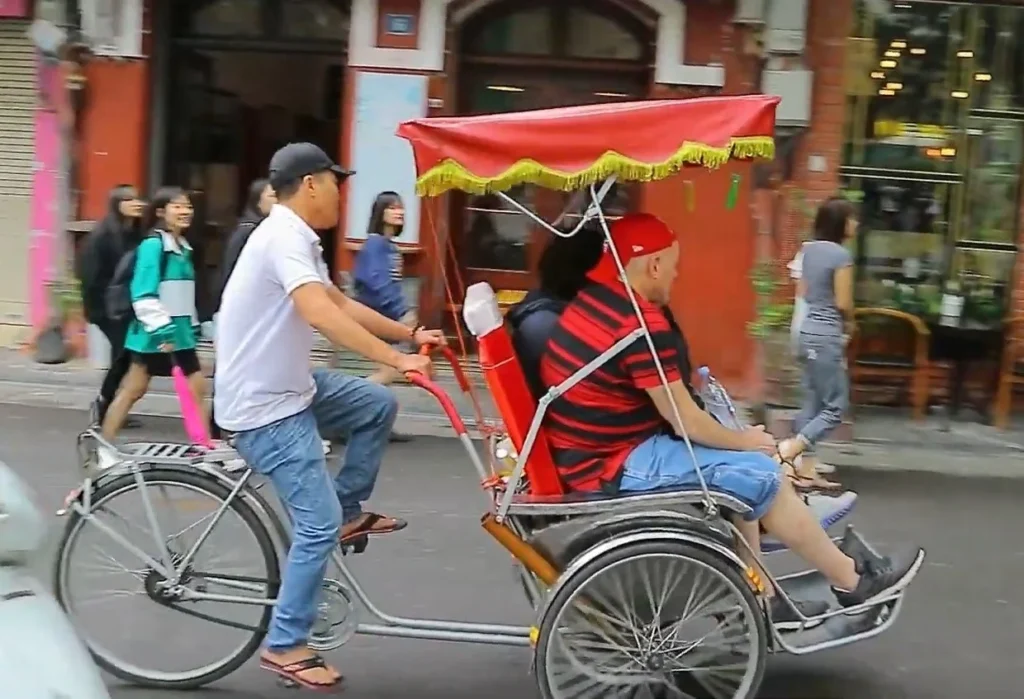
In tourist areas of Hanoi and Ho Chi Minh City, two street services have historically caused problems: cyclos and shoe shiners. Scams are less common than a few years ago, but the pattern is the same: someone offers a seemingly cheap service, you accept, and at payment time the price has multiplied.
With cyclos, the trick is not fixing the price before you get in, or fixing it vaguely: «100» can mean 100,000 VND (about $4) or $100, and 200,000 can become 200,000 per person. Always agree the price in advance, including currency and route. A reasonable price is 200,000 to 300,000 VND ($8 to $11) for a short ride around the centre.
Shoe shiners got me years ago, when I was new in Hanoi. I let a man clean my shoes at a café in the Old Quarter. We agreed on under $2, but as he worked he kept adding «extras» without asking: new laces, a special glue, another treatment I can’t even remember. The price ended up at about $12. Not a drama, but I clearly felt cheated. I refused to pay that much and, since we were in a café with witnesses, he gave my shoes back.
These days you see this kind of thing much less, but it never hurts to be careful.
Take your time with money
With money, two things deserve attention: how prices are given and how you handle banknotes. Both are solved with the same advice: don’t rush.
First, ask for the price in dong (VND). In tourist areas some sellers quote in dollars so you understand better, but at payment time they use whatever exchange rate suits them, usually worse than the real one. Always ask for the local price, and to convert it, check Google or an app like Wise.
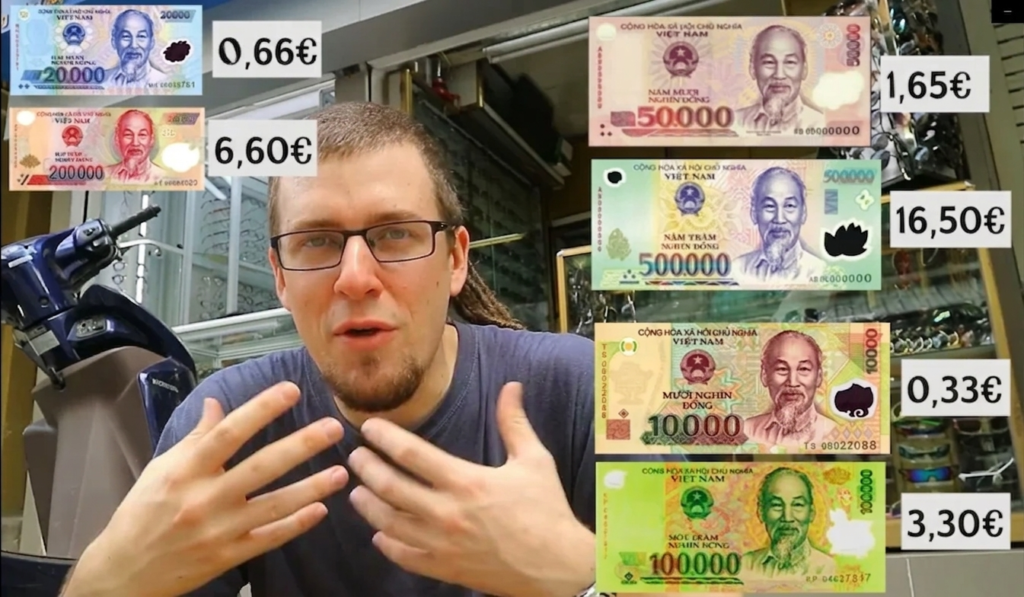
Also, Vietnamese banknotes have a lot of zeros. There are 6 types, from 1,000 to 500,000, and they’re easy to mix up at first: a 50,000 VND note is about $2, a 500,000 note about $19. Before paying, take a few seconds to understand what you owe and take the notes out yourself. If the person at the counter offers to pick the notes for you, politely ask them to wait. Most mean well, but a slip can cost you.
As a general rule, there’s no rush with cash in Vietnam. Ten extra seconds to look at the notes and confirm the price saves you 90% of money problems.
For more on managing your money in Vietnam (where to change it, which cards to use, whether you can pay by QR), see my guide on how to change money and pay in Vietnam.
Watch out for “gifts” put in your hand (or on your shoulder)
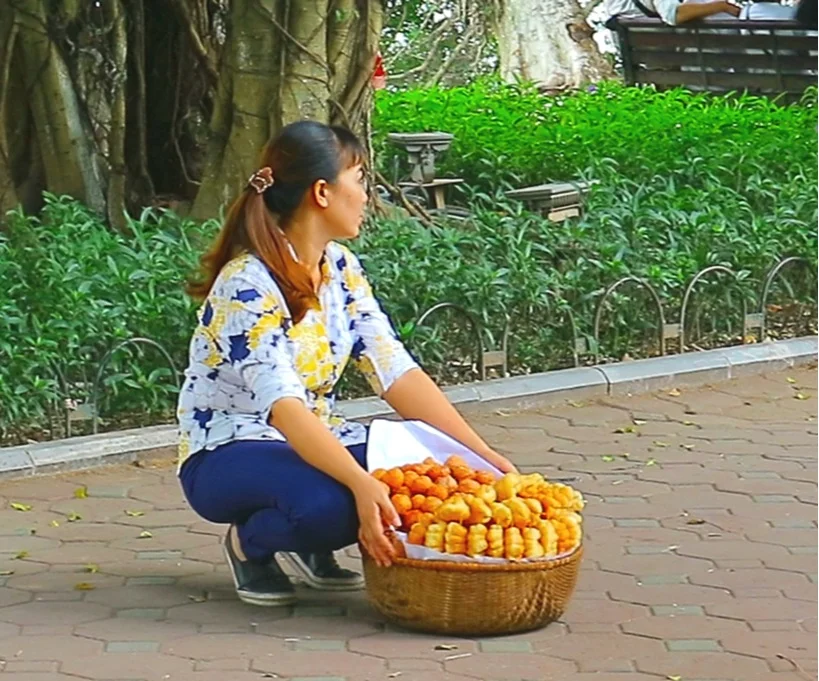
In tourist areas of Hanoi and Ho Chi Minh City several scams work the same way: someone comes up and offers you something, and before you decide you’re already holding it or carrying it on your shoulder. From then on, walking away without paying is awkward.
«Gifts» in Hanoi. Mainly around Hoan Kiem Lake and the Old Quarter. Someone puts a bun, fruit, a drink or a souvenir in your hand, hoping you’ll grab it by reflex. Once you’re holding it, you’re in the conversation. They usually ask for no more than $5 to $10, but it feels uncomfortable.
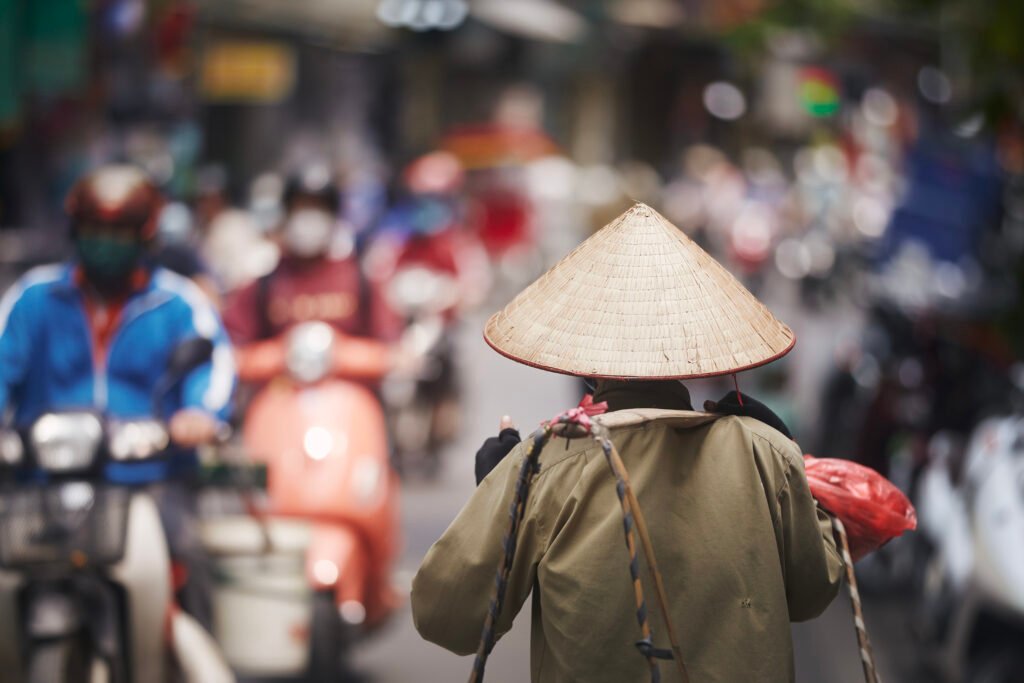
The fruit pole for photos (seen in Hanoi, Hoi An and Ho Chi Minh City). You’ll often see women carrying the traditional bamboo pole on their shoulder loaded with fruit, and in Ho Chi Minh City men with coconuts. Some come up to you, put it on your shoulders “for a photo” and, once you’re wearing it, ask for a tip, try to sell you fruit at inflated prices, or both.
In Ho Chi Minh City the coconut version is quite common. I once saw a street row between a tourist and a coconut seller that ended with the tourist kicking the box and walking off. I mention it to show how common it is, not as an example of how to react.
My advice: say «no, thank you» before the thing reaches your hands or shoulders, and keep walking. If you’re already holding something, give it back straight away, without opening it, tasting it or posing for a photo. If you’re interested, agree the price and pay before you get the food or take the photo.
Health and physical risks in Vietnam
Mosquito borne diseases

Mosquitoes are the main cause of illness in Vietnam, and for travellers the most relevant disease is dengue. I’ve lived here since 2017 and know of isolated cases among travellers, but it’s not common. Still, prevention is simple and worth it.
What works best for me: repellent with DEET or icaridin (on exposed skin every few hours) and permethrin spray, an insecticide for clothes, sheets or mosquito nets. I explain it in detail, with the products I use, in my guide on what to pack for Vietnam.
For more on prevention, my updated guide explains the recommended vaccines for travelling to Vietnam (including dengue), how much they cost and how to plan ahead (in Spanish).
Be careful crossing the road
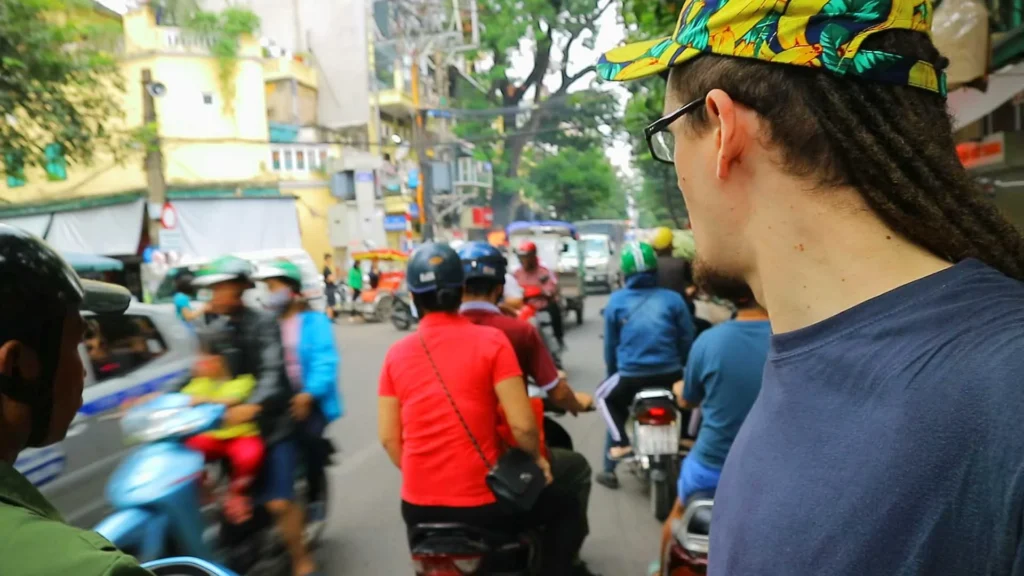
The traffic in Hanoi and Ho Chi Minh City will probably be the first thing that shocks you: hundreds of motorbikes moving in every direction, few clear pedestrian crossings, often not waiting for green. Crossing seems impossible the first time, but there’s a trick that works, worth learning from day one.
The rule is simple: wait for a moment of light traffic and walk slowly, at a steady pace, looking ahead and being predictable. Motorbikes will go around you, but only if they can predict where you’ll be a second later. If you run, stop suddenly or hop around, you become unpredictable, and that’s when accidents happen. It’s hard at first because it goes against your instincts, but with practice you’ll do it without thinking.
Why wait for light traffic: the more vehicles there are, the less room drivers have to avoid you. Social media has videos of people crossing through a flood of vehicles as if it were nothing; it’s really not a good idea.
I show it on video here, with real examples and a couple more tips (in Spanish):
Two important details:
- Don’t blindly trust traffic lights. Even when it’s green for pedestrians, keep looking: many vehicles turn diagonally or pull out without waiting.
- Let big vehicles go first. Lorries and buses have less room to swerve. Motorbikes go around you, buses don’t.
If you’re going to ride a motorbike, read up first
Motorbikes are a popular way to get around Vietnam, but there are real risks.
Traffic follows a different logic from Europe or North America. The rules exist, but in practice the size of the vehicle decides who has priority, which completely changes how you need to ride.
On top of that, some realities take time to sink in. Many people ride while looking at their phone (maps, texts, calls). Turns at junctions aren’t made at right angles but diagonally, so vehicles can cross in front of you against the flow, in your lane, before joining the lane on your left. And vehicles often pull out without looking, assuming everyone will avoid them.
So if you’ve never ridden a motorbike, Vietnam isn’t the place to learn. If you do have experience, spend your first few hours watching the traffic before riding in Hanoi or Ho Chi Minh City.
Two important things:
- Your licence. To ride legally in Vietnam you need an International Driving Permit for motorbikes issued under the 1968 Vienna Convention, so not every international permit is valid. I explain it in detail in my article on which international licence you need to drive in Vietnam.
- Insurance. In Vietnam it’s not realistic to get third party liability insurance for a rented motorbike (vehicle insurance doesn’t work for foreigners the way it does at home). What you do need is travel insurance that covers your medical costs if you have an accident. Check that your policy covers motorbike accidents and what licence it requires, and remember that travel insurance usually doesn’t cover damage to third parties, so if you cause an accident and someone else is involved, those costs are on you.
My final advice after 9 years living in Vietnam
If I had to sum up this article in one idea: go prepared, but go without fear. Vietnam is one of the safest countries in the world in the ways that really matter, which is one of the reasons I decided to live here. This isn’t meant to scare you, but so you arrive with peace of mind and can focus on enjoying the country.
One practical note: in tourist areas like Hanoi’s Old Quarter you’ll see lots of shops selling copies of brands like The North Face, Adidas or Nike. It’s not a scam! If you want to buy, haggle, compare shops and check the quality. More in my guide to The North Face shops in Hanoi.
And one last thing: for years I’ve been bringing travellers together in WhatsApp groups (mostly in Spanish) to share questions, recommendations and whatever comes up in real time. I’ve also just started a WhatsApp group for travellers to Vietnam in English: it’s small for now, but you’re very welcome to join and ask anything.
Enjoy your trip. Vietnam is a country that wins people over slowly, and it usually leaves its mark.
Frequently asked questions
Is Vietnam safe for women travelling solo?
It’s one of the questions I get asked most in my WhatsApp groups, and the answer usually comes from women travellers who are in the country or have been. The consensus: yes, Vietnam is one of the places in Southeast Asia where they feel most comfortable travelling alone.
Not only are harassment and assault rare; even uncomfortable stares or inappropriate comments are uncommon. Several say their most uncomfortable moments in bars or nightlife came from drunk foreign tourists rather than local men.
The precautions are the usual ones: don’t accept drinks from strangers and use Grab or Green SM instead of taxis when going home at night.
If you’re travelling solo and want to hear it first hand, leave a comment or ask in my new WhatsApp group in English.
Is it safe to walk around Hanoi or Ho Chi Minh City at night?
Yes. Vietnam is very safe by night as well as by day, in residential areas and on the outskirts of big cities like Hanoi, Ho Chi Minh City or Da Nang. Streets are usually lively until eleven or midnight, with street vendors, people eating on the pavement and places open. And many women travellers in my WhatsApp groups mention that, even on quiet streets, it’s unusual for someone to follow or approach you with bad intentions, unlike in many Western cities. Vietnamese women I’ve talked to confirm it.
Either way, the basic precautions you’d take in any city in the world are still a good idea.
Is overnight transport (sleeper buses) safe?
Generally, yes. Sleeper buses are one of the most used forms of transport for travellers in Vietnam, and serious accidents are rare. Still, keep in mind:
Drivers sometimes go fast on bumpy back roads, which makes the journey uncomfortable. Keep your phone, wallet and passport on you at all times (not in your backpack or the seat pocket): theft on buses is rare, but it happens.
I book with Baolau and Vexere, which has a wide range and lets you compare operators. Choose companies with good reviews (Hai Van, Queen Cafe and The Sinh Tourist are usually reliable) and avoid the cheapest, which tend to have older buses.
Is street food safe?
Safer than many people think. Most street food is boiled, grilled or deep fried, which kills bacteria. I’ve eaten at street stalls every day for years without a serious problem.
I go into detail, including what to do about salads and fresh herbs, in my guide to vaccines for travelling to Vietnam.
Is the ice in drinks safe?
Yes. Vietnamese people know tap water isn’t drinkable, so ice in bars and restaurants is bought made from filtered water or made with boiled water. Nothing to worry about, especially in tourist places.
I explain more in my guide to vaccines for travelling to Vietnam, where I also talk about water and food.
Are there areas with landmines or unexploded bombs?
Yes, but not where a normal traveller goes. The war left unexploded ordnance (UXO), mainly in central provinces like Quang Tri, Thua Thien Hue and parts of Quang Binh. These areas are signposted, and the usual tourist routes (including guided DMZ tours) are safe.
If you visit these areas, don’t leave marked paths or wander into open fields without a local guide. In the usual tourist areas (Hanoi, Halong, Ninh Binh, Sapa, Ha Giang, Hoi An, Ho Chi Minh City) this risk doesn’t exist.
What should I do in a medical emergency (with or without insurance)?
With travel insurance, first call your insurer’s 24 hour assistance line, usually through their app. They’ll tell you which hospital to go to, arrange direct payment and support you through the process.
Without insurance, it gets complicated. International private hospitals (Vinmec, French Hospital, Family Medical Practice) are the best option for foreigners but expensive: a basic emergency visit with a few tests can cost around $350, and a few days’ stay can easily run into thousands. Public hospitals are cheaper, but language and procedures can be a real obstacle without a local to help. And if you’re admitted, I’ve seen crowded wards with two people sharing one bed; it’s fairly common.
That’s why I always recommend travelling with insurance, and I go into detail in my guide to travel insurance for Vietnam.
What should I do if something is stolen in Vietnam?
First, go to the nearest police station and report it. They’ll ask for your passport and give you an official report, which your insurer needs for your claim; without it, most insurers won’t pay out.
If your passport was stolen, after reporting it contact your embassy or consulate for an emergency travel document.
In tourist areas, police stations are easy to find. If communication is hard, ask your hotel: staff often go with you or call the police for you.
Any more questions about safety in Vietnam?
If you have questions about your trip or a worry I haven’t covered, leave it in the comments and I’ll be happy to help. I’ve also just started a WhatsApp group in English: it’s small for now, but you’re very welcome to join and ask anything.
To have everything sorted and travel with total peace of mind, I recommend reading these next: